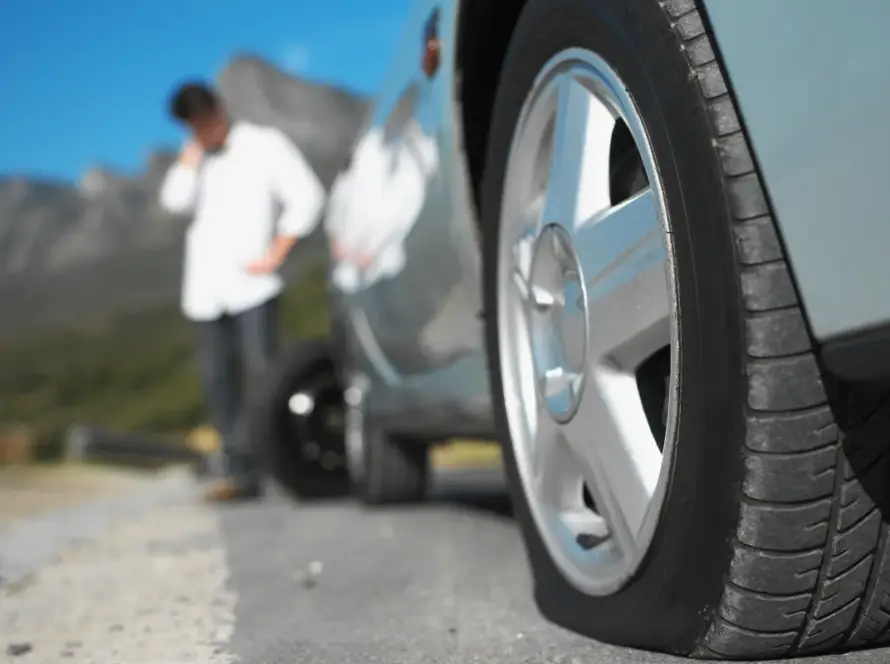
Decide first whether the car is safe to move, because that single answer changes everything after it. A slow deflation with a warning light means drive to somewhere you can legally stop. A blowout, a bulge or a tyre already flat means stop where you are and get help to the vehicle. London adds a layer the rest of the country does not have: the place you stop carries a penalty charge, and the van coming to you has to get into the same space legally.
The situations this covers:
- A blowout in moving traffic
- A pressure warning on the dashboard
- Pothole or kerb damage
- A flat in a car park
- A tyre that cannot be repaired
What Counts as an Emergency
Three states, and only one of them means stop immediately.
Stop now. A bang and a pull, a visible bulge in the sidewall, a tyre that is flat rather than soft, or any vibration that arrived suddenly. Driving on destroys the tyre, usually the wheel, and sometimes the arch and wiring behind it.
Move carefully to a safe place. A pressure warning with the car still driving normally, or a slow deflation you have noticed over days. Keep the speed down and the distance short.
Book it in. A nail sitting in the tread and holding pressure, uneven wear, or a tyre near the legal limit. These are appointments, not emergencies.
The legal minimum tread is 1.6mm across the central three-quarters of the tyre and around the whole circumference. Below that is a £2,500 fine and three penalty points per tyre, which is the one case where a non-urgent tyre becomes urgent the moment you are stopped.
Stopping Legally Is the London Problem
Everywhere else you pull over. Here you pull over and then deal with the consequences.
Red routes, bus lanes, cycle lanes and permit bays all carry charges that can apply even when the vehicle has broken down, and a camera does not know why you stopped. Get off the carriageway into a side street or a legal bay wherever the car will still move, because the difference between stopping in the right place and the wrong one is often the price of the tyre again.
Where you can and cannot stop, and what to do if a penalty notice arrives anyway, is set out in full in flat tyre in London.
A Blowout in Moving Traffic
The most frightening of these, and the one with the clearest rule.
Hold the wheel firmly with both hands and come off the accelerator. Do not brake. The deflated tyre creates enough drag to slow the car on its own, and braking adds a second force to a vehicle that is already being pulled to one side.
Steer towards the left only once the speed has fallen and the car is tracking straight. On a dual carriageway or the North Circular, that means planning across lanes rather than making one movement. The full procedure is in tyre burst while driving.
A Pressure Warning in Traffic
The light tells you something changed; it does not tell you what.
Pull in where it is legal and look at all four tyres. A tyre that is visibly low has lost air and needs attention before you go further. A tyre that looks normal with the light still on may be a sensor fault or a temperature change rather than a leak.
The system triggers at around 25% below the correct pressure, so by the time it lights up the tyre is already well down rather than marginally soft. What each warning pattern means is covered in tyre pressure warning light.
Do not use an aerosol sealant unless you have no alternative. It contaminates the inside of the tyre, and many fitters will not repair afterwards because a patch cannot bond to the coated surface. A repairable puncture becomes a replacement.
Pothole & Kerb Damage
London surfaces do more of this than open roads, and the damage is often delayed.
After a heavy impact, check the sidewalls for any raised area, the rim for flat spots or cracks, and the pressures the following morning. A bulge means the internal cords have snapped and the tyre can fail without further warning, whatever the tread looks like.
Parking against a high kerb scuffs sidewalls routinely and most of it is cosmetic, removing only the sacrificial rib. The test is whether cord is showing and whether the rubber gives under pressure. The full check list is in driving over potholes.
Who to Call
Three routes, and they do not do the same job.
Breakdown cover gets a patrol to you and fits your spare. A large share of cars now carry a sealant kit rather than a wheel, and the cost of the tyre itself usually stays yours.
A mobile fitter arrives with the replacement in the van, which is the difference that matters when there is no usable spare.
A garage means getting the car there, which a flat tyre makes impossible without recovery.
Which to ring for which situation is set out in tyre breakdown in the UK. Whichever you choose, ask for the full figure before the van moves, including the specific tyre being fitted.
Car Parks, Estates & Access
Where the car is sitting decides whether anyone can reach it.
Underground car parks have height restrictions that a fitting van will not clear, so the car usually has to come up to street level or the work happens after a recovery. Gated estates and permit-only bays need someone to let the van in and a legal place for it to stand while the wheel is off.
Tell the fitter the access situation when you book rather than when they arrive. The constraints inside the Congestion Charge zone specifically, including charging hours and where a van can legally work, are covered in mobile tyre fitting Central London.
Where We Reach Across London
Our coverage runs from Kent into the south-eastern boroughs rather than across the whole capital.
That takes in the Bromley and Orpington side through mobile tyre fitting in Bromley, and the Sidcup and Bexley corridor through mobile tyre services in Sidcup, along with the A20 and A2 routes between them.
If you are further into central London, say so when you call so we can tell you honestly whether we are the fastest option or whether someone closer will reach you sooner.
Frequently Asked Questions
Can I get a parking ticket while broken down in London?
Yes. Cameras record the stop, not the reason. Many authorities will cancel a notice on appeal with evidence of the breakdown, so keep the invoice and any photographs.
How quickly can a mobile fitter reach me in London?
It depends on the borough, the time and the traffic. Ask for an estimate when booking rather than assuming a standard window, and say where the car is sitting.
Is it safe to drive a short distance on a flat tyre?
No. A few hundred metres destroys the inner liner and usually the rim, turning one replacement into two. Move only if you are in a live traffic lane.
Will tyre sealant get me home?
Sometimes, for a small tread puncture. It will not seal a sidewall tear or a large gash, and it removes the option of repairing the tyre afterwards.
Does a tyre emergency affect my Congestion Charge?
The charge applies to the vehicle being in the zone on that day, so a breakdown does not cancel it. Pay it as normal and appeal separately if you think the circumstances justify it.
KMT Services brings the replacement tyre to the vehicle, which is what turns a London tyre emergency into a roadside job rather than a recovery and a day without the car.
We cover emergency puncture repair and 24/7 mobile tyre call-outs across the south-eastern boroughs and the Kent routes into them. Call 07443 370744, email info@kmtservices.co.uk, or find us at 1 Fareham Walk, Maidstone ME15 8UW.